
Some industries are moving faster than others to deploy agentic AI, but a new report from autonomous AI knowledge platform company Teradata suggests they are all running into a version of the same problem: Their data is too fragmented, sensitive or disconnected and lacks critical context for AI agents to act on reliably at scale.
The findings show healthcare, manufacturing, retail, and financial services each face different operational and regulatory hurdles. Yet all are confronting the same core challenge of turning enterprise data into something trustworthy enough for autonomous decision-making. This shift goes beyond connecting data systems and requires enriching that data with the business-level context and metadata that agents need to take correct and decisive action.
Agentic AI maturity across verticals
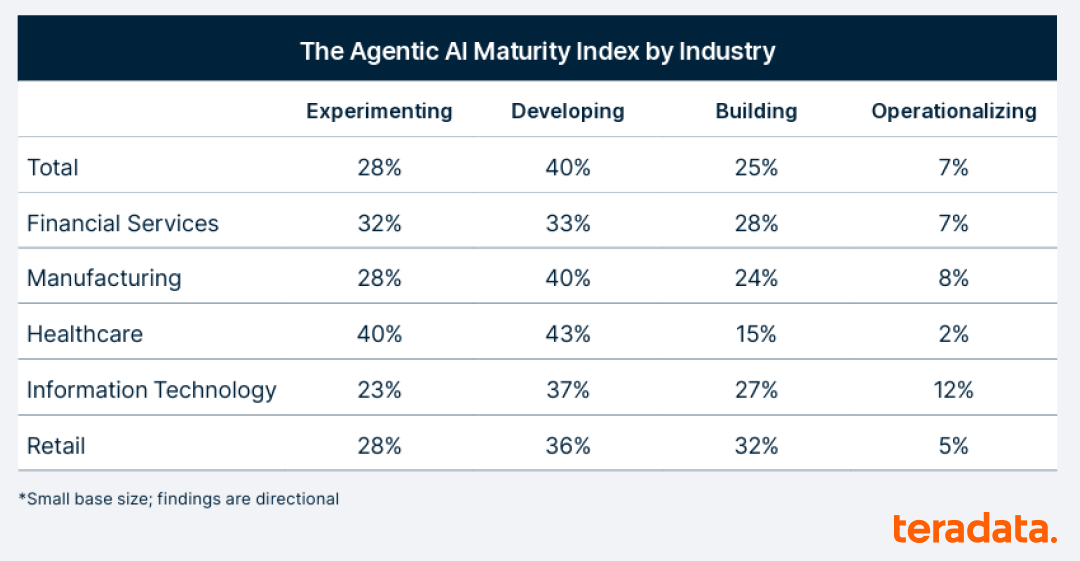
Every market has unique challenges when it comes to regulatory hurdles and operational barriers. The report uses an Agentic AI Maturity Index to categorize where organizations stand in their efforts to test, build and operationalize their AI investments. The four stages are:
- Experimenting (28% of the market): Exploring localized pilot projects, learning how AI helps individuals work better, and beginning to think about broader data strategies
- Developing (40% of the market): Some successful models, but no shared mechanism to build the enterprise context in the data necessary for agentic AI and still struggling to navigate the personal-to-organizational transition
- Building (25% of the market): Structured local governance and basic automated workflows, but still lacking the data foundation necessary for organizational scale
- Operationalizing (7% of the market): Has harmonized significant portions of their data, established dynamic safety rules, and has started to see AI confidently execute multi-step workflows. Early results show measurable impact.
The small percentage of companies in the Operationalizing stage are the ones achieving Autonomous Knowledge, which the report defines as “data with enough context, lineage, and governance for agents to act on it reliably.”
By analyzing where companies in these verticals land within the Agentic AI Maturity Index, the report shows how data fragmentation shows up across different markets.
Healthcare: Disparate systems, high sensitivity, harder lift
Due to the highly specialized, sensitive and regulated nature of healthcare records and their disparate technology systems, 90% of healthcare leaders report that 20% or less of their data is sufficiently described and contextualized for agents to act on it reliably (vs.77% average across all organizations surveyed). Often, health data is fragmented across disparate Electronic Health Record (EHR) systems.
While patient privacy is always to be protected, the data complexity and compliance requirements in healthcare are barriers to operationalizing Autonomous Knowledge. In fact, 42% of the healthcare organizations surveyed intentionally restrict their agents’ scope so a human always executes the final action. This leaves 83% of healthcare organizations stuck in the Experimenting or Developing stages, with agentic AI applications limited to basic (low-risk) administration use cases, like billing. Only 2% are in the Operationalizing stage, the lowest across all the industries examined.
Manufacturing: Ideal use cases, persistent legacy barriers
Manufacturing presents some of the clearest use cases for agentic AI, and 87% of manufacturing leaders surveyed in the report see agentic AI as a competitive opportunity. From optimizing supply chains to using IoT to predict equipment maintenance, the field is ripe for agentic AI use cases.
Despite the opportunities, only 8% of manufacturing organizations have moved into the Operationalizing stage. A key challenge is connecting data from advanced cloud-based services and tools with legacy manufacturing systems. The disconnect affects model performance and accuracy, which 54% of manufacturing leaders cite as a top barrier to deployment. An equally difficult challenge has been the lack of AI and data specialists to improve those connections.
Retail: A customer-centric catch 22
The retail industry faces a similar situation as manufacturing: The opportunity is high, and retailers typically hold a great deal of consumer data, but it’s spread across multiple disconnected systems, from e-commerce platforms to brick-and-mortar point-of-sale systems to third-party providers.
Almost half of retail leaders (48%) rely on customer satisfaction and experience metrics as the primary way to measure ROI from agentic AI. A similar number (46%) prioritize customer engagement and service for autonomous deployment, but since data fragmentation limits functionality like autonomous inventory management or personalization, the industry is struggling to realize returns. Only 5% of retailers are in the Operationalizing stage, the second lowest among industries studied.
Banks and financial institutions: A high cost to getting it wrong
Perhaps unsurprisingly, banks and financial institutions place the highest weight on enterprise-wide ROI (65% compared to the 62% across all respondents), but the uniquely complex context and data fragmentation within the industry makes entrusting any decision-making to fully autonomous AI particularly risky. An agent that drops context mid-execution could result in a failed regulatory audit. One that issues a bad loan or misses a critical fraud signal could put millions at risk in real time.
To that end, 50% of financial services organizations report that governance, security or access restrictions fundamentally limit their agents’ access to enterprise data. Limited data access and context means less opportunity to operationalize agentic AI across the entire enterprise, but financial institutions have to make sure the proper context and governance layers are in place to mitigate the risk of a wrong decision. These organizations are trying—they have the most equitable spread across the Experimenting, Developing and Building stages across all industries studied—yet only 7% have made it to the Operationalizing stage.
Unique challenges
By examining verticals within the context of the Agentic AI Maturity Index, it’s apparent that opportunities for achieving ROI abound, but domain-specific barriers affect progress in ways that are specific to each market.
Notably, two common themes across industries are risk and a lack of accuracy due to disconnected systems. As a result, the majority of organizations across all of these verticals remain in the Experimenting and Developing stages. A quarter find themselves in the Building stage, and just 7% on average are achieving enterprise-wide ROI in the Operationalizing stage. The biggest roadblock they all face is a data and context fragmentation problem, and this foundation must be built before companies can unlock organizational ROI from agentic AI investments.