테라다데이터 정보
테라데이터는 기업들이 지능을 자율적 행동으로 전환할 수 있도록 지원하며, AI 에이전트가 깊은 비즈니스 맥락과 신뢰할 수 있는 데이터에 기반을 두도록 합니다. AI 에이전트가 늘어나면서, 테라데이터는 기업들이 지금 필요로 하는 컨텍스트 엔진, 거버넌스 계층, 그리고 성능 기반이 되었습니다. Teradata 자율 지식 플랫폼은 클라우드, 온프레미스, 하이브리드 환경에서 AI를 생산에 투입합니다.
Teradata (NYSE: TDC) today released findings from a commissioned Wakefield Research study of 1,000 senior technology and data leaders across six global markets. The report, "Arrested Automation: Why Agentic AI Stalls at the Enterprise Level," finds that while enthusiasm to deploy agentic AI is near-universal, foundational data systems were not built for agents and need rethinking to deliver the ROI organizations expect.
Many of the hurdles outlined in the report (and summarized below) are easier to understand by recognizing the need to move from personal AI — tools like chatbots and writing assistants that help individuals work faster — to organizational AI, which works on behalf of the whole company using shared knowledge, appropriate access levels, and well-designed governance. The returns enterprises are chasing don't happen until AI operates at the organizational level.
The report introduces the Agentic AI Maturity Index to track where organizations stand on that journey and charts a path forward through what it calls Autonomous Knowledge — enterprise data with enough context, lineage, and governance for AI agents to act on it reliably at scale.
The Agentic AI Maturity Index: Where Enterprises Actually Stand
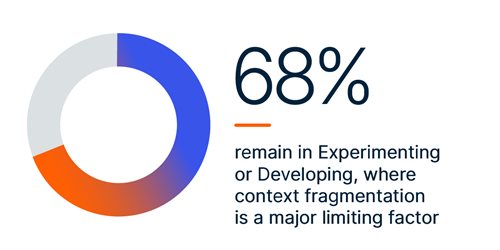 This four-stage framework maps where organizations stand: Experimenting, Developing, Building, and Operationalizing, which is where AI is executing multi-step workflows with measurable business impact. Currently, only 7% of the global enterprises have reached the final stage where tangible outcomes occur. The majority (68%) remain in Experimenting or Developing, where context fragmentation — when data exists but carries no usable meaning for agents — is a major limiting factor.
Notably, 69% of C-suite executives say their organization is already operating with agentic AI, while only 57% of VPs say the same.
The report breaks down findings across industries including healthcare, financial services, IT, manufacturing, and retail, and across six markets: the United States, United Kingdom, France, Germany, Japan, and Saudi Arabia. The agentic AI challenge is a global phenomenon, but not a uniform one. The research points to several barriers.
Nine in ten (90%) senior technology leaders 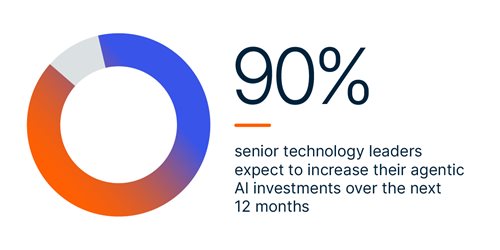 expect to increase their agentic AI investments over the next 12 months; yet nearly two-thirds (63%) report they have seen no more than a small or emerging positive return on those investments to date. The gap between investment and returns is not a lack of ambition, but a data foundation that was built for human users, not autonomous AI agents.
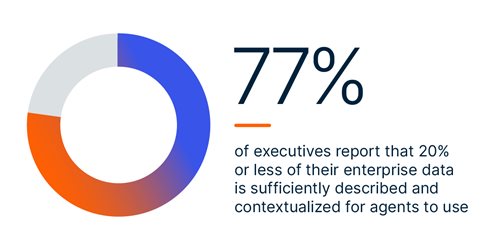
At the core of the agentic AI stall is context fragmentation: enterprise data that lacks the meaning, lineage, and governance AI agents need to act reliably across an organization. According to the report, 77% of executives report that 20% or less of their enterprise data is sufficiently described and contextualized for agents to use. And 78% find it challenging to unify data and knowledge across business functions so agents can reason across the full enterprise.
 The top two barriers leaders cite — data lacking the necessary metadata, context, and relationships (43%) and data fragmented across systems that cannot be connected in real time (42%) — point to the same root problem. The challenge isn’t how much data organizations have, but whether that data carries enough meaning to be trusted when agents use it. When it cannot, the pilot does not make it to production. 40% of tech leaders report that more than 40% of their AI pilot projects fail to reach production because infrastructure systems were never built for autonomous use. Only 15% of organizations are successfully getting 80% or more of their AI pilots into production.
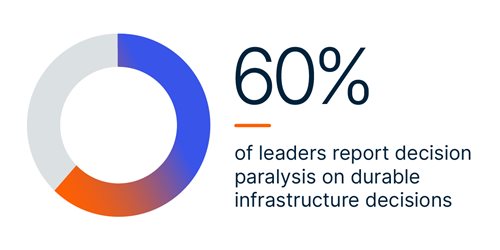 Even when organizations make progress on context fragmentation, implementing autonomous action is still hard. 60% of leaders report decision paralysis on durable infrastructure decisions. The hesitation may not be about technology selection (though 30% are worried about vendor lock-in) but instead a lack of trust in what's being deployed. Until organizations trust the data their agents are operating on, they won't let those agents act autonomously. 51% of leaders cite accuracy and reliability of outputs as a significant deployment barrier.
There is also a location problem. AI output currently lives outside the systems where consequential work actually happens. When intelligence is surfaced inside a tool or app where someone is already working, action follows. When it lives in a separate dashboard, it usually does not. Both problems stem from the same deficit: data that lacks enough context, lineage, and meaning to be trusted.
The report identifies Autonomous Knowledge as what organizations need to move from personal AI to organizational AI. It outlines a phased approach: audit and contextualize the highest-value portions of the data estate, embed governance directly into the data layer, and build for architectural portability. Organizations that have done this are already seeing returns. Those that have not are still waiting for their pilots to reach production.
Arrested Automation: Why Agentic AI Stalls at the Enterprise Level was conducted by Wakefield Research on behalf of Teradata. The study surveyed 1,000 senior technology and data leaders at the vice president level or above, at companies with a minimum of 500 employees, across the United States (500), United Kingdom (100), France (100), Germany (100), Japan (100), and Saudi Arabia (100). Fieldwork was conducted between March 23 and April 5, 2026.
To download the full report, visit: https://www.teradata.com/insights/white-papers/why-agentic-ai-stalls-enterprise
테라데이터는 기업들이 지능을 자율적 행동으로 전환할 수 있도록 지원하며, AI 에이전트가 깊은 비즈니스 맥락과 신뢰할 수 있는 데이터에 기반을 두도록 합니다. AI 에이전트가 늘어나면서, 테라데이터는 기업들이 지금 필요로 하는 컨텍스트 엔진, 거버넌스 계층, 그리고 성능 기반이 되었습니다. Teradata 자율 지식 플랫폼은 클라우드, 온프레미스, 하이브리드 환경에서 AI를 생산에 투입합니다.