Agentic AI Workloads: What They Demand of Your Data Platform
Report title: Projecting Analytic Data Workloads for Agentic AI — Why Enterprise Scale Agentic Workloads Demand a Different Kind of Data Platform
By Richard Winter | WinterCorp, 2026
RESEARCH DISCLOSURE
This research was sponsored by Teradata. See Methodology, sources and sponsorship below.
Enterprises are on the threshold of a new era in which intelligent agents, powered by generative AI and operating with significant autonomy, will handle much of the routine work. IDC forecasts that AI will generate $22.5 trillion in cumulative global economic value by 2031 (IDC, April 2026). Yet many organizations are planning large-scale agentic AI deployments without asking whether their existing data platform can handle the workload.
The impact of agentic AI on the data platform is a change that is unprecedented in the history of digital data and analytics. — Richard Winter, WinterCorp
The Scale of What's Coming
Agents generate far more data platform interactions than humans. A single business question that previously produced one SQL query can now generate tens to hundreds of queries as an autonomous agent reasons, retrieves, validates, and retries in iterative loops (the "reason, act, observe" pattern).
Most of the added queries are short probes that retrieve a single piece of business context, a piece of metadata, or a handful of data values.
-
20×
Estimated starting increase in database query volume as agents take on work from humans, growing rapidly with maturity (WinterCorp estimate)
-
10s–100s
Queries per business question: tens at Level 1, hundreds at Level 4, versus typically one for a traditional BI query
-
68%
of surveyed enterprises are at Level 1 or 2 of agentic maturity (Wakefield Research, 1,000 executives) — see the maturity model below
The Four Levels of Agentic Maturity
Most organizations will progress through four levels of agentic maturity, a model developed by Wakefield Research. At each level agents do more work, interact with more enterprise data, and generate more queries against the data platform. For planning purposes the WinterCorp report assumes each level takes about one calendar year; organizations can adjust that once they have specific plans.
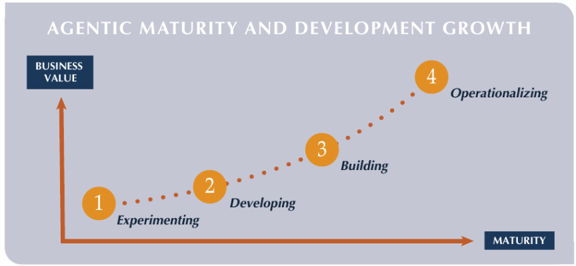
Figure: The four levels of agentic maturity and development growth. Source: WinterCorp report, Figure 2, p. 9, based on the Wakefield Research maturity model.
|
LEVEL |
WHAT IT LOOKS LIKE |
QUERIES PER BUSINESS QUESTION |
|
1. Experimenting |
Localized pilot projects. Organizations are learning how AI helps individuals work better and beginning to map broader data strategies. |
Tens |
|
2. Developing |
Successful models, but no shared way to assemble the right context for the right agent. Each team has its own definitions, data and rules; moving from personal to organizational AI is the defining challenge. |
Rising |
|
3. Building |
Structured local governance and automated basic workflows, but the data foundation was not built for organizational scale. The barrier is whether the data layer can support agents operating across functions. |
Rising |
|
4. Operationalizing |
Deliberate architectural investments harmonizing significant portions of data, dynamic safety rules, and AI confidently executing multi-step workflows (for example, a multi-agent system managing equipment and maintenance in a semiconductor plant). Autonomous Knowledge is under active development. |
Hundreds |
Why Most Platforms Aren't Ready
Traditional analytic data platforms were built for business intelligence: periodic, complex queries submitted by human analysts. Agentic AI produces a fundamentally different workload — high-frequency, concurrent, mostly short queries — often at the same time as complex analytics and real-time data updates.
Business intelligence vs. agentic AI: what the data platform must do
WinterCorp contrasts the analytic data platform most enterprises have run in recent years (pre-2026) with the autonomous knowledge platform it says agentic AI requires (2026 and beyond). The capabilities marked "NO" are ones the report says have not been expected of data platforms over the last decade.
|
CAPABILITY REQUIRED |
BUSINESS INTELLIGENCE: ANALYTIC DATA PLATFORM (PRE-2026) |
AGENTIC AI: AUTONOMOUS KNOWLEDGE PLATFORM (2026+) |
|
BI query and reporting |
YES |
YES |
|
Classic machine learning |
YES |
YES |
|
Business context |
NO |
YES |
|
Agentic workloads at scale* |
NO |
YES |
|
Vector data type and indexing |
NO |
YES |
|
Semantic search |
NO |
YES |
|
Natural language query at scale |
NO |
YES |
|
Autonomous operation |
NO |
YES |
-
100s ×
Efficiency gap WinterCorp observed between some widely used platforms on large numbers of short queries (private client benchmarks)
-
7%
of surveyed organizations have reached Level 4, Operationalizing (Wakefield Research)
-
$22.5T
IDC forecast of cumulative global economic value from AI by 2031 (IDC, April 2026)
Three Critical Requirements for the Agentic Era
Deploying agents at scale imposes three requirements on the data platform — requirements that go far beyond what today's platforms were designed to provide:
1. Become a Knowledge Platform
Agents need business context — not just data and schema — in order to link a business question to the data that can answer it. The platform must store, curate, and retrieve on demand the business context of enterprise data, including knowledge graphs precisely defining relationships between words, concepts, and data objects, and vector embeddings expressing semantic similarity.
2. Become Autonomous
Workloads generated by agents are dynamic and largely unpredictable. The platform must self-optimize and self-manage in response to intensive, rapidly changing workloads — with little or no human intervention. Manual tuning and configuration cannot keep pace with hundreds or thousands of concurrent agents each acting on their own tasks and goals.
3. Achieve a New Kind of Scalability
The platform must process enormous volumes of short queries rapidly and at near-zero cost per query, while simultaneously processing complex analytics and handling high-volume data updates. In private benchmarks conducted for enterprise clients, WinterCorp found some widely used platforms to be hundreds of times more efficient than others on this class of workload (see the benchmark conditions above). That efficiency will no longer be optional.
In short, the enterprise of the agentic era will need an autonomous knowledge platform to manage its data.
Methodology, Sources and Sponsorship
Sponsorship and independence
This WinterCorp report was sponsored by Teradata. WinterCorp states that it is based on independent work by WinterCorp and its affiliates. Teradata briefed WinterCorp on its ongoing efforts to project agentic AI workloads and requirements, and reviewed the report with respect to facts. The opinions and conclusions in the report are exclusively WinterCorp's. See the methodology statement on p. 4 of the report.
Where each statistic comes from
|
STATISTIC |
WHAT IT MEASURES AND UNDER WHAT CONDITIONS |
SOURCE |
|
20× increase in database queries |
WinterCorp estimate (not a measured result) that query volume starts at about 20× today's level as work shifts from humans to agents, then grows rapidly. Basis: queries per business question (about one for a typical BI request vs. tens at Level 1 and dozens to hundreds for sophisticated agents) and more business activity handled by agents. |
WinterCorp report §3.2–3.4, pp. 13–14 |
|
Tens to hundreds of queries per business question |
Agents run iterative reason–act–observe loops with multiple retrievals, validations and retries. Level 1 agents generate tens of interactions per business question; at Level 4 the typical agent generates hundreds of short queries. |
Report §3.1–3.2, pp. 12–13; §5.1, p. 19. Underlying research: Yao et al., ICLR 2023; Xu et al., 2026 |
|
Hundreds of times more efficient on short queries |
Private WinterCorp benchmarks for enterprise clients comparing widely used data platforms on large numbers of concurrent short queries (efficiency, and cost-effectiveness under high concurrency). Platforms, configurations and results are not published in the report. |
Report §5.1, p. 19 |
|
68% at Level 1 or 2; 7% at Level 4 |
Wakefield Research survey of 1,000 enterprise executives. Level definitions (Experimenting, Developing, Building, Operationalizing) are Wakefield's. |
Report §2.1, pp. 9–10; Wakefield Research: Arrested Automation |
|
$22.5 trillion by 2031 |
IDC forecast of cumulative global economic value generated by AI (all AI, not agentic AI alone), driven by productivity gains, new revenue models and business transformation. |
How WinterCorp projects agentic workloads
WinterCorp recommends starting with a workload projection tool that combines the scale of the existing data warehouse workload, anonymized customer system telemetry, known agentic database interaction patterns and the organization's agentic maturity level. It describes the output as a rough estimate, to be replaced as soon as strategy is clear by use-case estimates built from target business outcomes, before/after scenarios and event frequencies, then validated with simulation, a realistic benchmark at scale, or a pilot. Report §4.1–4.4, pp. 15–17
Limitations
Projections are estimates. WinterCorp notes that early-stage estimates rest on broad industry experience and do not reflect any one organization's agentic strategy, and that there is little production experience with agentic AI at large scale. Natural language query volumes in particular carry considerable uncertainty and should be tested across a range of frequencies.
Additional sources cited in the report
Kalappurackal Mansoor, I., Phadke, A., & Rana, P. (2026). Verified Tool Calls Improve LLM Agent Reliability Under Non-Atomic Failures. arXiv. · Garcia, J. & Malarme, P. (2024). Baseline Agentic AI Systems Architecture. Microsoft Azure AI Foundry Blog. · ReAct Agents: Reasoning, Acting, and Tool Calls, NVIDIA DLI.
Frequently asked questions
What is an autonomous knowledge platform?
What is an autonomous knowledge platform?
An autonomous knowledge platform stores and manages data, business context (knowledge graphs, vectors), and schema — and self-optimizes its own operations. It is what enterprises need instead of a traditional analytic data platform once agents are deployed at scale.
How does an autonomous knowledge platform differ from a traditional analytic data platform?
How does an autonomous knowledge platform differ from a traditional analytic data platform?
A traditional analytic platform supports BI query and reporting and classic machine learning. WinterCorp says agentic AI adds requirements not expected of data platforms over the last decade: business context, agentic workloads at scale (very large numbers of concurrent short queries), vector data type and indexing, semantic search, natural language query at scale, and autonomous operation. See the comparison table above.
Why do agentic AI workloads stress data platforms so differently?
Why do agentic AI workloads stress data platforms so differently?
Autonomous agents operate in iterative reasoning loops, generating tens to hundreds of short database queries per business question instead of the single SQL query a human or BI tool would submit. High concurrency of short queries is a workload pattern most analytic platforms were not designed for.
How much will query volume increase with agentic AI?
How much will query volume increase with agentic AI?
WinterCorp estimates that database query volume starts at about 20× today's level as agents take on work from humans, and grows rapidly as organizations move through the four maturity levels. The estimate reflects the number of queries per business question (one for a typical BI request; tens at Level 1; hundreds at Level 4) and the growing volume of business activity handled by agents. It is an estimate, not a measured result. See Methodology, sources and sponsorship above.
What are the four levels of agentic maturity?
What are the four levels of agentic maturity?
Experimenting, Developing, Building and Operationalizing, a model from Wakefield Research. Wakefield found 68% of surveyed enterprises at Level 1 or 2 and 7% at Level 4. See the maturity model above.
What is business context and why do agents need it?
What is business context and why do agents need it?
Business context is the knowledge that links a business question to the data that can answer it — which tables and columns are relevant, what business rules apply, how concepts relate to each other. Without it, agents cannot reliably answer real business questions, even with accurate data.
What is natural language query (NLQ) and how does it affect the platform?
What is natural language query (NLQ) and how does it affect the platform?
NLQ lets end users ask business questions in plain language, which agents translate into data queries. When made available to large user populations, NLQ unleashes large latent demand for analytics, generating a flood of complex queries on top of the agent workload — an additional unprecedented demand.
How can organizations prepare before agents go live at scale?
How can organizations prepare before agents go live at scale?
Start with a workload projection tool for a rough estimate, then refine via use-case analysis, quantified architectural requirements, and realistic benchmark tests. Ensure your data platform can handle the projected workload before — not after — agentic AI solutions reach production at scale.
Does platform choice matter?
Does platform choice matter?
Yes, significantly. In private benchmarks conducted for enterprise clients, WinterCorp found some widely used platforms to be hundreds of times more efficient than others on large numbers of concurrent short queries, and far more cost-effective under high concurrency. The report does not name the platforms tested.
Who sponsored this research, and is it independent?
Who sponsored this research, and is it independent?
Teradata sponsored the report. WinterCorp states the work is independent, that Teradata reviewed the report only for facts, and that the opinions and conclusions are exclusively WinterCorp's.