개요
Predictive analytics is an advanced analytics discipline that uses a combination of current and historical data to find patterns indicative of likely future events, trends, or business outcomes.
It's among the most highly valued branches of analytics for enterprise-scale organizations across multiple industries, from finance and logistics to telecommunications and manufacturing.
The fundamentals of predictive analytics
Like all forms of data analytics, predictive analytics rests on a foundation of massive datasets. Three of the five Vs of big data—volume, variety, and veracity—apply here, as it's not feasible for even a cutting-edge analytics engine to generate realistic predictions without a great deal of information as its baseline. The data in some of these sets can be weeks, months, years, or decades old; other sets may include key performance indicators (KPIs) generated as recently as several hours ago.
Parsing these vast swaths of data requires the careful use of various mathematical, statistical, and data science techniques. Some of these principles, like linear and logistic regression analysis, are based on centuries-old—but still sound—mathematics, while others, like decision tree modeling and data mining, are considerably more modern. Coupled with parameters—variables that address the entirety of specific categories under examination within data sets—these methods help pinpoint patterns to predict occurrences and situations that will likely occur. Sometimes—though not always—predictive insights include roughly specified times at which various future outcomes will unfold.
In a way, predictive analytics is a fascinating fusion of the classical and the cutting edge—primarily because it wouldn't be possible without state-of-the-art technologies. This stems most obviously from the sheer volume of data, which is too great for human data scientists and analysts to contend with manually. But the pace, efficiency, and efficacy that even smaller enterprises require to gain actionable insights and tangible business value from analytics also can't be left to human manual analysis. Database technologies and business intelligence (BI) software solutions were among the earliest tools used to help automate and streamline data analysis at scale, and these days, few tech trends have greater influence on analytics than artificial intelligence (AI) and machine learning (ML).
Predictive vs. prescriptive analytics
Predictive analytics and prescriptive analytics are often compared, but they serve different roles within a broader analytics strategy. Predictive analytics focuses on estimating what is likely to happen in the future by analyzing historical data and identifying patterns. Prescriptive analytics builds on those predictions by recommending specific actions an organization should take in response.
In practice, prescriptive analytics depends on predictive models as one of its key inputs. It combines those forecasts with optimization techniques, mathematical modeling, business rules, and often machine learning algorithms to evaluate possible decisions. The result is guidance on how to achieve a desired outcome, whether that means maximizing revenue, reducing risk, improving operational efficiency, or meeting regulatory constraints.
Rather than replacing predictive analytics, prescriptive analytics extends it. Predictive models highlight potential outcomes and probabilities, while prescriptive analytics helps determine the best course of action given those projected scenarios.
| Dimension | Predictive Analytics | Prescriptive Analytics |
|---|---|---|
| Core question answered | What is likely to happen? | What should we do about it? |
| Primary goal | Forecast future outcomes based on patterns in historical data | Recommend optimal actions to achieve desired results |
| Key inputs | Historical data, statistical models, machine learning predictions | Predictive model outputs, business rules, constraints, optimization models |
| Typical techniques | Regression, classification, time-series forecasting, machine learning models | Optimization algorithms, simulation models, decision analysis, rule-based systems |
| Output | Probabilities, risk scores, forecasts, predicted behaviors | Recommended actions, decision paths, optimal resource allocations |
| Example use case | Predict which customers are likely to churn | Recommend the best retention offer for each at-risk customer |
| Role in analytics maturity | Identifies likely future scenarios | Determines best actions within those scenarios |
Major benefits of predictive analytics
Reliability and accuracy set modern predictive analytics apart from past methods used to forecast sales, inventory, scheduling, occupancy, revenue, and a wide variety of other critical business KPIs. Predictive analysis is especially useful for helping companies find and take advantage of patterns within data—whether to highlight risks and opportunities, examine relationships with third-party partners, or optimize supply chain management.
The heart of decision-making
Arguably, the most important benefit of predictive analytics—regardless of specific application—is its potential to majorly improve enterprise decision-making.
Company leaders and the heads of various business units can't rely solely on direct knowledge, training, and intuition to make the right calls in critical situations—or small ones that can snowball into larger issues. These turning points may affect any or all of the following: bottom-line margins, jobs, key business operations, the customer experience—and even, in fields like healthcare, patients' lives. Only with the foundation of sound data, experienced data professionals, and a predictive analytics solution capable of leveraging past events to envision future possibilities can enterprise-scale organizations enable consistent, reliably strong decision-making.
Other noteworthy benefits of predictive analysis are tied to decision-making in one way or another. Risk mitigation, demand forecasting, and predictive maintenance all exemplify this fact.
- A large enterprise using a predictive analytics model trained and configured to analyze the soundness of acquiring a subsidiary company knows the precise level of risk it faces if the model projects that the startup's bad fundamentals will overcome its promising R&D.
- A retailer with projections of strengthening consumer confidence understands that it may need to increase inventory but that it can raise prices on certain goods.
- A manufacturer using a supervised machine learning model to assess equipment health can plan to repair or replace any individual device that shows signs of trouble.
Ultimately, human choice—likely an alliance of key stakeholders—will determine how each of these organizations proceed from the findings of their models. But regardless of outcome, predictive analytics gave enterprise leaders the support they need to make via actionable insights in all of these situations.
Predictive analytics modeling use cases
Predictive analytics is widely used across industries because it allows organizations to anticipate behavior, demand, and risk before events occur. By combining historical data with machine learning models and statistical techniques, organizations can uncover patterns that inform marketing strategies, operational planning, customer engagement, and risk management.
Different industries apply predictive models in different ways depending on the data available and the outcomes they need to forecast. Marketing teams often focus on customer behavior and campaign performance. Healthcare providers analyze patient data to identify risk and improve care decisions. Travel and hospitality companies forecast demand and pricing opportunities, while financial institutions and insurers rely on predictive modeling to detect suspicious activity and reduce fraud.
The following examples illustrate how predictive analytics models are commonly applied across industries.
| Industry / Function | Predictive Analytics Use Case | Data Analyzed | Business Value |
|---|---|---|---|
| Marketing and sales | Customer segmentation, churn prediction, and campaign targeting | Purchase history, customer demographics, engagement data, support interactions | More personalized campaigns, improved conversion rates, stronger customer retention |
| Healthcare | Patient risk prediction and care optimization | Patient records, treatment history, diagnostic results, lifestyle indicators | Earlier intervention, improved patient outcomes, more efficient resource allocation |
| Travel and hospitality | Demand forecasting and dynamic pricing | Booking patterns, travel behavior, seasonal trends, market demand data | Optimized pricing strategies, higher occupancy or booking rates, improved customer experience |
| Financial services and insurance | Fraud detection and risk monitoring | Transaction data, device information, geolocation, behavioral patterns | Faster fraud detection, reduced financial losses, improved regulatory compliance |
| Retail and e-commerce | Product recommendation and demand forecasting | Purchase behavior, browsing history, inventory levels, seasonal patterns | Higher average order value, improved inventory planning, better customer engagement |
| Operations and supply chain | Predictive maintenance and demand forecasting | Equipment sensor data, production metrics, supply chain data | Reduced downtime, optimized maintenance schedules, improved supply planning |
The importance of machine learning in predictive analysis
While forms of automation and AI have been a part of analytics since fairly early in the discipline's history, the rise of machine learning is nothing short of an analytics game-changer.
Because ML models constantly grow more effective by ingesting new data and being periodically retrained to improve their performance, they make analytics more dynamic than ever. Also, due to ML's enablement of natural language processing (NLP), a business user doesn't have to be a data scientist or analyst to input queries: They can type—or, often as not, use voice recognition—to submit data requests in sentences that they'd regularly type or speak, instead of in snippets of Python or R.
Furthermore, within the ML subcategory of deep learning, predictive analysis using neural networks becomes sophisticated enough to be valuable in complex fields like oncology and pharmaceuticals: For example, a convolutional neural network (CNN) can accurately classify skin cancer with the veracity of a dermatologist, while a deep feed-forward neural network (D-FFNN) can predict drug toxicity more effectively than other deep learning models. Although deep learning requires a great deal of computing power and the technology is still in development, the evidence for its potential thus far is quite promising.
Operationalizing predictive analytics
Making predictive analytics work for your organization starts with envisioning a clear objective: You must have at least one intended application for this practice in mind, or it will become a resource drain. It can be relatively straightforward to start—e.g., conducting sentiment analysis regarding a particular product to gauge the likelihood of customers buying similar goods in the future. You can move on to other use cases if this first one is a success.
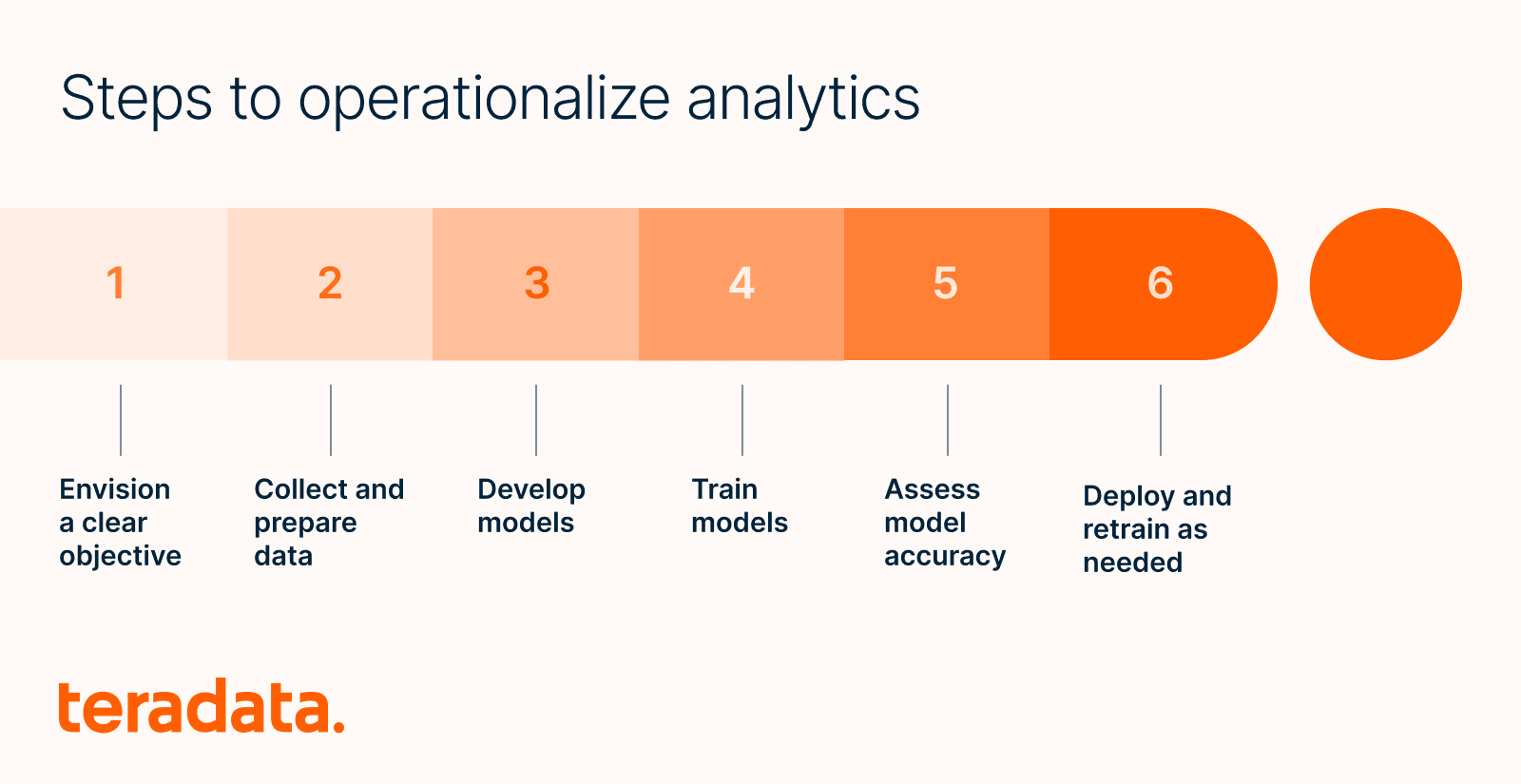
Next is data collection and preparation, which entails not only identifying every relevant data set but also filtering out redundant or noisy data that will skew results. Model development follows—devising appropriate algorithms and pairing them to the data you wish to predictively analyze. Then comes training, in which the model "learns" the data inside and out, which will eventually enable it to make predictions. Various assessments test the accuracy of the model's initial predictions, and recoding or other tweaks take place as needed. Finally, it's deployed in its working environment—and brought back for retraining and maintenance when necessary.
Carrying all of this out, of course, requires strong enterprise data architecture, dedicated data pipelines, effective data warehousing, object stores to enable data lakes for unstructured data, and more. You'll also need a foundation of cutting-edge technology—an effective cloud deployment, AI/ML solutions, and a powerful data platform.
Maximize predictive analytics' business value with VantageCloud
Teradata VantageCloud enables your enterprise to operationalize predictive analytics in the manner most valuable to the business. The complete cloud and data analytics platform integrates and streamlines data from disparate sources across your enterprise so it's easily accessible to predictive models. With its AI/ML-driven ClearScape AnalyticsTM engine, VantageCloud can help launch numerous predictive models quickly and support analytics operations that generate actionable insights and form the basis of sound strategy.
Predictive analytics FAQs
What are the main types of predictive analytics?
What are the main types of predictive analytics?
Predictive analytics uses various models and techniques to forecast future outcomes based on historical data. Main types include:
- Decision trees use a tree-like structure to represent decisions and their possible consequences, making them useful for understanding the factors leading to specific outcomes
- Neural networks are important in fields requiring pattern recognition and complex data analysis, such as image and speech recognition, and predictive maintenance
- Regression models predict continuous outcomes and are widely used in finance, marketing, and healthcare for tasks like sales forecasting and risk assessment
- Time series models analyze data over time, such as stock market analysis, economic forecasting, and demand planning
What kind of data is used for predictive analytics?
What kind of data is used for predictive analytics?
The importance of different types of data can vary depending on the specific application and industry. Kinds of data used include:
- Historical data collected over time—such as sales records, customer interactions, and financial transactions—to identify trends and patterns
- Transactional data generated from day-to-day operations—such as purchase histories, payment records, and inventory levels—to enable real-time analysis and forecasting
- Behavioral data produced from user behaviors and interactions—such as website engagement, social media activity, and customer feedback—that helps to explain and predict customer preferences and actions
- Demographic data related to the characteristics of individuals or groups—such as age, gender, income, and education level—used to provide more relevant and personalized service
What are the potential drawbacks or risks of predictive analytics?
What are the potential drawbacks or risks of predictive analytics?
While predictive analytics offers numerous benefits, there are several potential drawbacks and risks to consider:
- Data quality issues, including inaccurate, incomplete, or biased data that can lead to misleading predictions and flawed decision-making
- Privacy concerns about the use of personal data, necessitating compliance with data protection regulations and protection of user trust
- Ethical considerations, such as biases present in data that can lead to unfair or discriminatory outcomes
- Interpretability of complex models, which can make it challenging to understand and justify decisions to stakeholders
These risks can be mitigated by ensuring data quality, anonymizing personally identifiable information (PII), regularly checking for biases, and using transparent models.