개요
Private AI is the practice of deploying artificial intelligence models and the data that trains them inside an organization's own controlled environment—on-premises, in a private cloud, or in a sovereign enclave—so that sensitive data, proprietary model weights, and regulated workloads never leave the enterprise perimeter.
Unlike public AI services that send data to shared, vendor-managed models, private AI keeps data, inference, and governance under a single accountable owner. For regulated industries, private AI is increasingly the only architectural pattern that satisfies both AI ambition and compliance reality.
Defining private AI
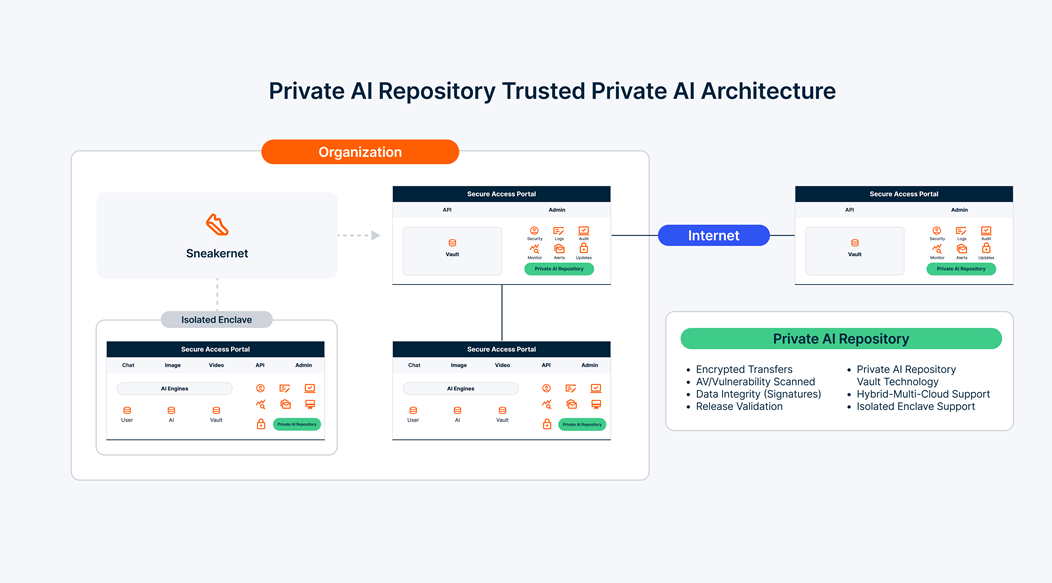
Private AI refers to the deployment of artificial intelligence systems inside an environment an organization controls directly, rather than on infrastructure operated by a third party. In practical terms, that means the data used to train or ground a model, the model weights themselves, and the compute that runs inference all remain within defined organizational boundaries—whether that is an on-premises data center, a dedicated private cloud, or a sovereign enclave operated under strict residency requirements.
It's important to distinguish private AI from the related but separate concept of AI privacy. AI privacy is a user-facing concern: it addresses what happens to the queries, prompts, and personal information individuals submit to AI applications like public chatbots. Private AI is an organizational architecture concern: it addresses what happens to an enterprise's data, proprietary knowledge, and model intellectual property when AI is deployed at scale. The two overlap, but they are not interchangeable—and the distinction matters when enterprise leaders are evaluating where AI fits in their governance model.
The deployment patterns that qualify as private AI sit on a spectrum. At one end, fully on-premises private AI offers the strongest form of control: every data byte and every model weight resides on infrastructure the organization owns and operates. A private cloud arrangement, in which dedicated tenancy is provided by a trusted vendor, reduces capital expenditure while preserving most of the sovereignty benefits. At the far end, confidential computing in a public cloud uses hardware-based encryption to isolate workloads from the cloud operator itself—a meaningful step forward, but one that still requires trusting infrastructure outside the enterprise perimeter.
How private AI works
A private AI deployment is best understood as a stack of four functional layers, each with a specific purpose in keeping data, models, and governance aligned.
The data layer
The foundation of any private AI system is its data. In a private AI architecture, training data, retrieval-augmented generation (RAG) document stores, and vector embeddings all reside on storage the organization controls. Nothing is copied to an external service for processing, and nothing is exposed to a third party's training pipeline. For enterprises that have spent decades building trusted systems of record—customer data, transactional history, clinical records—private AI ensures the AI workloads of the future draw on that same governed foundation.
The model layer
The model layer holds the algorithms that turn data into predictions, classifications, or generated content. In a private AI deployment, this includes base models (often open-weight foundation models deployed into the enterprise environment), fine-tuned models trained on proprietary data, and the embeddings that support retrieval. Model weights are, in many ways, the most sensitive asset a private AI system protects—a fine-tuned model has absorbed the organization's accumulated knowledge and, once trained, represents institutional intellectual property that cannot be allowed to leak.
The inference layer
Inference is where a prompt becomes an answer. In a private AI system, the inference layer runs on enterprise-controlled compute—often GPU-accelerated—and returns responses without sending the prompt or its context to an external API. This architecture delivers two important properties: latency is predictable, because traffic stays on the enterprise network; and sensitive content in prompts, such as clinical notes or customer records, never leaves the perimeter.
The governance layer
The governance layer is what makes private AI defensible to auditors, regulators, and the enterprise's own risk and compliance teams. It enforces access controls, logs every prompt and response, maintains model lineage, and supports the audit trails that prove—after the fact—who used which model, on which data, for what purpose. Governance is not an overlay on private AI; it is a design property of it.
Source: https://www.redrake.com/portfolio-items/trusted-private-artificial-intelligence
Private AI vs. public AI
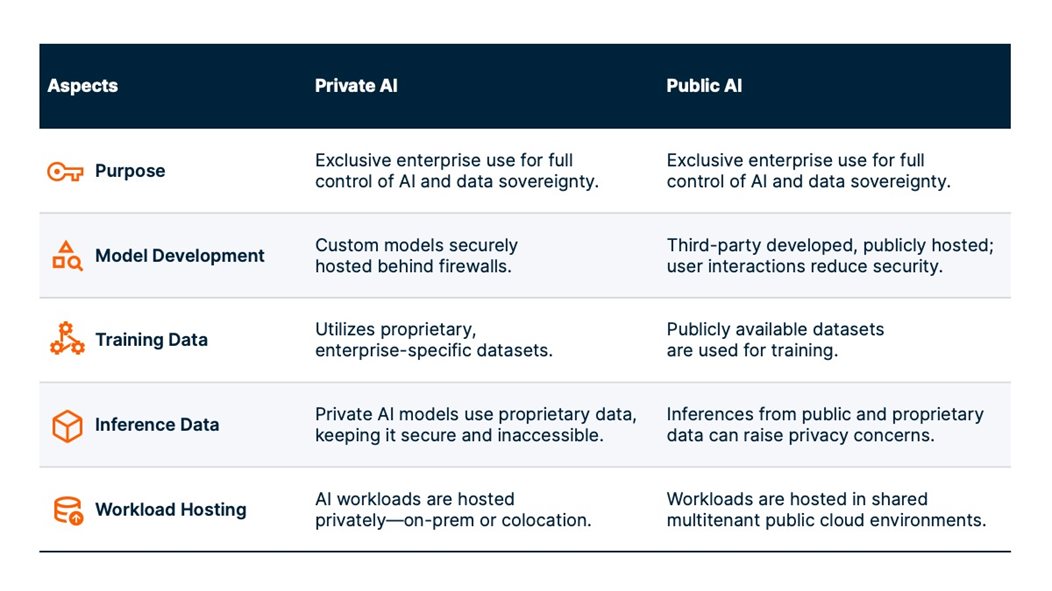
The choice between private AI and public AI is less about which is "better" and more about which architectural trade-offs an enterprise is willing to make. Public AI services offer rapid access to frontier capabilities and scale that no single organization could replicate on its own. Private AI offers control, data sovereignty, and the ability to keep proprietary knowledge genuinely proprietary.
Public AI is built for speed and breadth, while private AI is built for control and defensibility. Neither is universally the right answer. Low-sensitivity workloads that benefit from rapid iteration often run well on public AI services. Regulated workloads, workloads that depend on proprietary knowledge, and workloads with strict data residency requirements almost always require the private AI pattern — and increasingly, enterprises are adopting hybrid approaches that route specific workloads to whichever model fits.
Benefits of private AI
For enterprises operating in regulated or IP-sensitive environments, the benefits of private AI are structural rather than incremental.
- Data sovereignty. Data never crosses the enterprise perimeter, which means data residency requirements, contractual privacy obligations, and sector-specific regulations like HIPAA, GDPR, PCI DSS, and FedRAMP are satisfied by the architecture itself rather than by vendor attestations.
- Model ownership. Fine-tuned model weights represent accumulated institutional knowledge — a bank's compliance standards, a hospital's clinical reasoning patterns, a manufacturer's defect-detection heuristics. In private AI, those weights remain the enterprise's intellectual property, not a shared asset inside a third party's training pipeline.
- Predictable cost and latency. Per-token pricing scales uncomfortably at enterprise volume. Private AI shifts the cost profile to capital expenditure plus predictable operating expense, and inference latency becomes a function of the enterprise network rather than a vendor's API.
- Defensible audit trails. Every prompt, retrieval, and response is logged on infrastructure the enterprise controls, producing the kind of complete, time-stamped record that auditors and regulators expect to see.
- Alignment with existing governance. For organizations that already operate mature data governance programs, private AI extends existing controls—access management, lineage, audit, retention—to cover AI workloads, rather than requiring an entirely new governance model to accommodate external vendors.
Privacy-preserving techniques in private AI
Private AI is not a single technique—it is a stack of them. Several distinct approaches, often used together, make it possible to run AI on sensitive data without compromising the integrity of that data or the models that learn from it.
Federated learning
Federated learning allows a model to be trained across multiple organizations or data silos without moving the underlying data. Each participant trains the model locally on their own data; only the model updates—not the data itself—are shared and aggregated. This pattern has particular relevance in healthcare consortia and cross-border financial collaboration, where the value of a shared model is high but the data cannot legally be pooled.
Differential privacy
Differential privacy provides a mathematical guarantee that individual records cannot be reverse-engineered from a model's outputs. By introducing carefully calibrated noise into training or inference, organizations can make statistical use of sensitive data while ensuring that no single record's contribution can be isolated. Differential privacy is increasingly a baseline expectation for AI systems trained on personal or regulated data.
Confidential computing
Confidential computing uses hardware-based secure enclaves to isolate workloads from the infrastructure that runs them. Inside the enclave, data and code remain encrypted even during processing, meaning that neither the cloud operator nor a compromised host operating system can read what the model is working with. For enterprises running AI in private cloud or confidential-compute-enabled public cloud, this is often the mechanism that elevates infrastructure trust to an acceptable level.
Synthetic data
Synthetic data is artificially generated data that preserves the statistical and relational properties of real data without containing actual records. In private AI, synthetic data can extend training sets, support experimentation in less-controlled environments, or enable data sharing across teams otherwise blocked by privacy rules. The usefulness of synthetic data depends heavily on the quality of the generation process—poorly generated synthetic data can introduce bias or miss the statistical tail behavior that matters most in production.
On-premises vs. private cloud: Which form of private AI do you need?
"Private AI" is not a single deployment pattern—it is a spectrum, and the right point on that spectrum depends on the organization's risk profile, capital posture, and regulatory obligations.
- On-premises deployment places every layer of the AI system on infrastructure the organization owns and operates. It provides the strongest form of sovereignty: no third party has physical or logical access to the hardware, the data, or the models. The trade-off is capital expenditure and operational responsibility—the organization must invest in and maintain the infrastructure itself.
- Private cloud deployment places the AI system on dedicated, single-tenant infrastructure provided by a trusted vendor. Sovereignty is preserved for most practical purposes, and the capital profile shifts to operating expenditure. The trade-off is that some portion of trust is delegated to the vendor, whose operational practices now sit inside the threat model.
- Confidential computing in public cloud uses hardware-based encryption to isolate workloads from the cloud operator itself—a meaningful advancement that allows enterprises to run sensitive AI workloads in shared infrastructure with strong cryptographic guarantees. It reduces the amount of trust required in the cloud operator, but it does not eliminate it; the enterprise is still running on infrastructure it does not own.
Each of these patterns qualifies as private AI by a reasonable definition. For enterprises whose threat models, regulatory obligations, or intellectual property concerns require the strongest possible form of control, on-premises deployment remains the anchor. For enterprises with different constraints, a private cloud or confidential-compute arrangement may offer the right balance of control and economics.
Industries that benefit most from private AI
Private AI adoption is strongest in industries where sensitive data, regulatory obligations, and proprietary knowledge intersect. In these sectors, public AI is often not a viable option—either by policy, by regulation, or by the commercial realities of protecting intellectual property.
Financial services
Financial institutions handle customer records, transactional data, and proprietary analytical models that cannot be exposed to external AI systems. Private AI allows banks to train models on know-your-customer documentation, build fraud-detection systems on full transaction histories, and deploy generative AI assistants for compliance officers—all without sending customer data or model weights outside the institution. A bank's proprietary compliance interpretation, accumulated over decades, is precisely the kind of asset private AI exists to protect.
Source: https://www.techaheadcorp.com/blog/private-ai-for-enterprises-a-game-changer-to-safeguard-the-business
Healthcare and life sciences
Healthcare organizations operate under some of the strictest data privacy regimes anywhere, and the penalty for a breach of protected health information is severe. Private AI enables hospitals to deploy clinical-notes summarization, medical image analysis, and patient-facing support tools without PHI leaving the hospital's governed environment. Life sciences organizations applying AI to drug discovery similarly rely on private AI to protect proprietary molecular data and research assets that represent years of investment.
Manufacturing
Manufacturers increasingly apply AI to quality inspection, predictive maintenance, and supply chain optimization. A manufacturer's defect-detection model, trained on images of production-line output, embeds a detailed understanding of its failure modes—information that competitors would pay to obtain. Private AI keeps that model, and the training data behind it, inside the manufacturer's own environment.
How Teradata supports private AI
Teradata's approach to private AI is grounded in the same principle that has shaped the company's data platform for decades: enterprise-scale workloads deserve enterprise-grade control. Private AI extends that principle to the full AI model lifecycle—secure fine-tuning on proprietary data, retrieval-augmented generation against sensitive document stores, governed model deployment, and complete audit and lineage for every prompt and response.
For enterprises that have already invested in trusted systems of record, the advantage is continuity. AI models trained alongside the warehouse-resident data that governs the rest of the business inherit the same access controls, the same lineage, and the same governance posture. There is no need to build a parallel governance model for AI workloads—they sit inside the one already in place.
Capabilities such as Teradata's Enterprise Vector Store, in-database AI/ML functions, and integrated support for open-weight foundation models through Bring Your Own LLM allow data and analytics teams to build, tune, and deploy AI without data or models ever leaving the environment they trust.
To learn more about how Teradata supports private AI at enterprise scale, connect with our team.
Frequently asked questions
Still have questions about private AI? Here are answers to some of the most common.
Is there an AI that is private?
Yes. A private AI system is one where the model, the data it uses, and the compute that runs inference all remain inside an organization's controlled environment. Options range from self-hosted open-weight foundation models running on enterprise GPUs, to dedicated private-cloud deployments, to confidential-compute arrangements in public cloud infrastructure.
How does private AI work?
Private AI works by keeping four layers—data, models, inference, and governance—inside infrastructure the organization controls. Training data and vector stores sit on enterprise storage; model weights are hosted on enterprise compute; inference runs without contacting external APIs; and every action is logged for audit and lineage. The result is an AI system where no prompt, no record, and no fine-tuned weight ever leaves the perimeter.
How much does private AI cost?
Private AI shifts the cost profile from per-token operating expense to a combination of capital investment and predictable operating costs. At low volume, public AI APIs are usually less expensive. At enterprise volume—and particularly for workloads with strict governance requirements—private AI is often more cost-effective over a multi-year horizon, because cost scales with infrastructure capacity rather than with query count.
What is the difference between private and public AI?
Public AI runs on shared, vendor-managed infrastructure; private AI runs inside an organization's own controlled environment. The difference shows up across every dimension that matters for enterprise governance: where data lives, who owns fine-tuned model weights, how governance is enforced, and how costs scale. Public AI optimizes for breadth and speed. Private AI optimizes for control, sovereignty, and IP protection.
What industries benefit most from private AI?
Regulated industries benefit most. Financial services, healthcare, life sciences, government, and manufacturing all operate with sensitive data, strict regulatory obligations, or proprietary knowledge that cannot be exposed to external AI systems. Any organization that would face material risk from a data leak, a model-weight leak, or a compliance breach is a candidate for private AI.
Is private AI the same as AI privacy?
No. Private AI is an organizational architecture concern—it addresses where data and models live, and who controls them. AI privacy is a user-facing concern—it addresses what happens to the queries individuals submit to AI applications. An enterprise can operate a private AI system and still need to think separately about AI privacy for the end users of its AI-powered products.
What are the best private AI tools?
Private AI is delivered through categories rather than single tools: a foundation model or fine-tuned model, compute infrastructure for training and inference, a vector store for retrieval-augmented generation, governance and lineage tooling, and the data platform that holds the organization's proprietary information. The best private AI tool is the combination that aligns with an enterprise's existing data estate, governance posture, and operational maturity.